

Nobel Prize for medicine awarded to immune system researchers
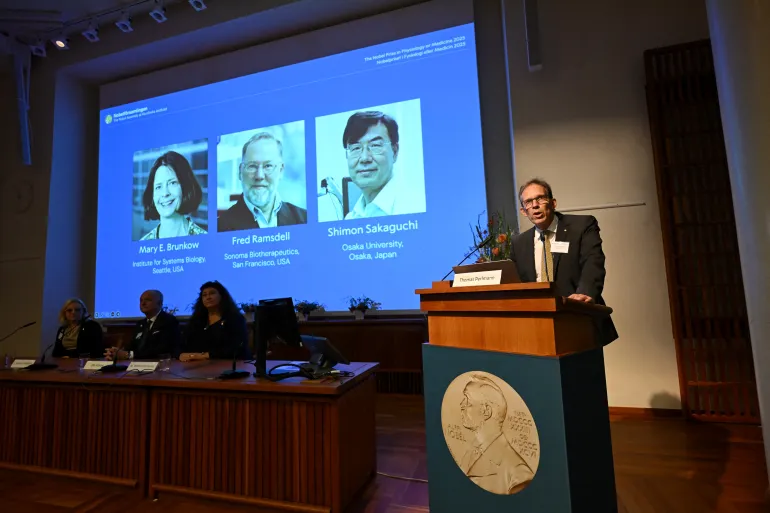
The Nobel Prize in physiology or medicine has been awarded to three scientists Mary E Brunkow, Fred Ramsdell, and Shimon Sakaguchi for their work on the functioning of the human immune system.
The award will be presented to the trio in December for “their groundbreaking discoveries concerning peripheral immune tolerance that prevents the immune system from harming the body”.
The research “relates to how we keep our immune system under control so we can fight all imaginable microbes and still avoid autoimmune disease”, said Marie Wahren-Herlenius, a rheumatology professor at the Karolinska Institute.
The prize of 11 million Swedish kronor ($1.17m) is to be shared equally between Brunkow and Ramsdell, both 64, of the United States and Japan’s Sakaguchi, 74. The king of Sweden will also present them with gold medals.
“Their discoveries have laid the foundation for a new field of research and spurred the development of new treatments, for example for cancer and autoimmune diseases,” the prize-awarding body said in a statement.
Olle Kampe, chair of the Nobel Committee, said the trio’s work has been “decisive for our understanding of how the immune system functions”.
Their work dates back to 1995, when Sakaguchi made the initial key discovery. Brunkow and Ramsdell made another breakthrough in 2001, before Sakaguchi linked all of their work two years later.
Thomas Perlmann, Secretary-General of the Nobel Committee, said he spoke to Sakaguchi by phone on Monday, and had left voicemails for Brunkow and Ramsdell.
“I got hold of [Sakaguchi] at his lab and he sounded incredibly grateful, expressed that it was a fantastic honour. He was quite taken by the news,” Perlmann said.
The prize for medicine kicks off the annual Nobel awards, arguably the most prestigious prizes in science, literature, peace and economics. The winners of the remaining prizes will be announced over the coming days.